rejuan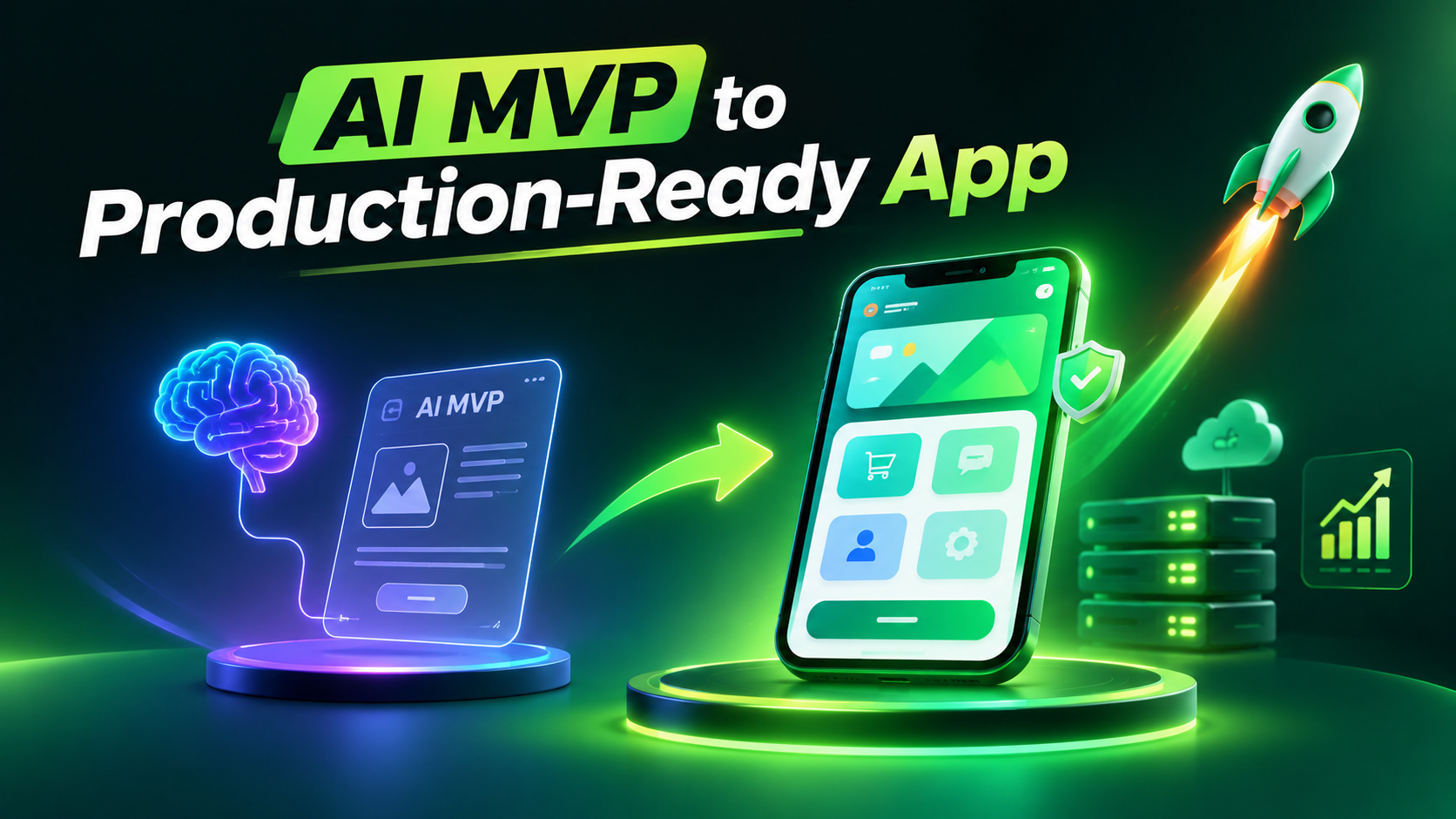
AI tools now let anyone build AI prototypes and test ideas quickly through rapid prototyping. The challenge is turning an AI prototype into a production-ready application that is ready for real users.
A prototype proves an idea — a production-ready app has to support real users, protect their data, scale as demand grows, and stay easy to maintain over time. Many founders launch AI-generated MVPs fast, only to run into messy code, performance issues, security risks — or workflows that don’t fully align with their business.
This guide explains how to turn an AI prototype to production, close the gap between prototype and production, and transform a prototype into a production-ready application.
The Rise of AI-Generated MVPs (and the Tools Behind It)
Usually, most people reach for AI first because it’s fast, cheap to start, and lets them validate an idea before committing a serious budget. A handful of tools now dominate this stage:
- Lovable and Bolt.new: Generate full-stack apps from a text prompt.
- Replit Agent: Builds and deploys in the same environment.
- v0: Generates frontend UI components fast.
- Cursor: An AI-native code editor built for developers who want more control.
- Claude Code and Codex: Command-line coding agents built for developers who want AI to write and edit code directly in their existing projects.
- Base44: A conversational app builder that generates a full-stack app, complete with database and hosting, from a text description.
- Bubble and FlutterFlow: No-code platforms suited to mobile apps.
These AI-powered platforms make rapid development possible and help founders build functional prototypes in hours. Most are excellent during the prototype stage, but they’re not designed for long-term production systems.
Why AI-Generated Prototypes Rarely Survive Contact With Live Users
An AI tool builds what you asked for. It doesn’t know what your business actually needs — and that gap is where most prototypes fall apart. Most tools focus on producing a convincing preview or demo instead of a real product. They prioritize core functionality over long-term quality.
It Solves the Demo, Not the Business
A prototype proves the happy path works: a user signs up, places an order, checks out. Real operations rarely follow the happy path. Exceptions, edge cases, and one-off requests are where the business lives, and a demo case doesn’t cover them.
Speed Comes Before Understanding
AI tools generate code fast, but speed isn’t the same as understanding. They don’t know your business rules, your compliance requirements, or how your systems need to talk to each other — so they skip all three.
“It Looked Done, But It Doesn’t Fit How We Operate”
This is the line founders say most often. The app runs. It doesn’t run the way the business works day-to-day.
Fine-Tuning Is a Different Job Than Building
Generating a workflow and refining it for how a business really operates are two separate skills — most AI tools stop at the first one.
Where AI-Generated Prototypes Actually Struggle
Once you move past the demo, the same problems show up across almost every AI-generated app. Here’s where they usually surface:
Inconsistent Code Quality
AI-generated code often mixes patterns and skips separation of concerns. One file might handle logic, data, and display all at once.
The Wrong Tech Stack
AI tools pick a stack for speed, not for what the product needs long-term. That choice catches up fast once the app has to scale.
Weak Maintainability
No documentation, no coding standards, no consistent structure. A new developer joining the project has to reverse-engineer it before they can touch it.
Security Vulnerabilities
Weak authentication, poor access control, missing validation, and exposed API keys are common — these gaps rarely show up until something goes wrong.
Performance Breaks Under Load
The app runs fine with 10 test users. At 1,000 concurrent users, it slows down or fails outright.
Painful Upgrades and Migrations
Nobody planned for future changes. Every upgrade or migration becomes a rebuild instead of an update.
The Hidden Cost of a “Half-Done” AI App
Building the first version cheap isn’t the same as building it cost-effective. What you save at launch, you often pay back later — with interest.
- Cheap to start, expensive to leave unfinished: A prototype costs little to generate. Leaving it half-built and shipping it anyway is what gets expensive.
- Technical debt compounds weekly: Every week an app runs on shortcuts, the eventual fix gets harder. What starts as a small patch turns into a rebuild.
- Rebuilding costs more than building right: Founders who skip the finishing work often pay for two builds instead of one — the first version, then the fix.
- Cost-effective means lowest total cost, not lowest price: The cheapest option upfront isn’t always the cheapest option overall — getting it right the first time usually costs less by the end.
From Prototype to Production: The Step-by-Step Process
Fixing an AI-generated app isn’t about starting over. It’s a defined sequence that turns what exists into something that holds up.
- Audit the Existing Codebase and Architecture
Before changing anything, map what’s there — know what to keep, what to rebuild, and what to remove. - Re-Validate Against Business Requirements
Check the app against how the day-to-day operations run — not what the prompt asked for. This is where hidden gaps surface. - Confirm or Correct the Technology Stack
Keep the stack if it fits the product’s needs. Replace it if it doesn’t — see the stack section below for how to make that call. - Refactor for Code Quality
Refactoring improves consistency, reduces technical debt, and prepares the application for future growth. Consistent code is easier to extend and debug later. - Harden Security
Fix weak authentication, add input validation, remove exposed keys, and update outdated dependencies — this step closes the gaps most prototypes leave open. - Optimize Performance and Plan for Scale
Production applications should be optimized for speed while supporting scalability and maintainability as usage grows. - Add Testing, CI/CD, and Monitoring
Automated tests catch problems before users do. CI/CD and monitoring keep the app stable after launch. - Document for Long-Term Maintainability
Write down how the system works — this lets a new developer contribute without rebuilding the whole app first.
Choosing the Right Technology Stack for Production
Choosing the right technologies determines how smoothly the application moves through its entire lifecycle and whether it can support enterprise-grade requirements:
- Expected traffic: A stack that handles 100 users a day won’t necessarily hold up at 10,000. Plan for where the product is going, not where it is now.
- Team’s long-term maintenance capacity: The best stack is the one your team can support after launch — not the one that built the demo fastest.
- Integration needs: Payment gateways, third-party APIs, and existing business systems all narrow the field. The stack has to fit what it needs to connect to.
- Proven over trendy: Most production apps run on .NET Core, Python, AWS, and Azure — technologies with long track records and strong long-term support.
Moving from prototype to production isn’t only about fixing code. It’s about preparing the application for production systems, production environments, and reaching production
How Wafi Solutions Takes AI-Generated Apps to Production
Wafi Solutions has spent 12+ years building and fixing software, having delivered 100+ projects for clients across the UK, USA, Australia, Canada, and Bangladesh. The KhaasFood mobile app, for example, reached 23,000 active users with zero paid campaigns after launch — proof that a properly built app earns growth instead of buying it.
Wafi helps founders turn an AI prototype into a secure application ready to launch. Our developers work with founders, product managers, and product teams to deliver production-ready software.
 Wafi Admin
 Ariful Islam